AI could make us richer. Will workers feel it?
A brief opinion on Anthropic’s AI economic scenarios: growth, workers’ share of income and what productivity should mean for your working life.
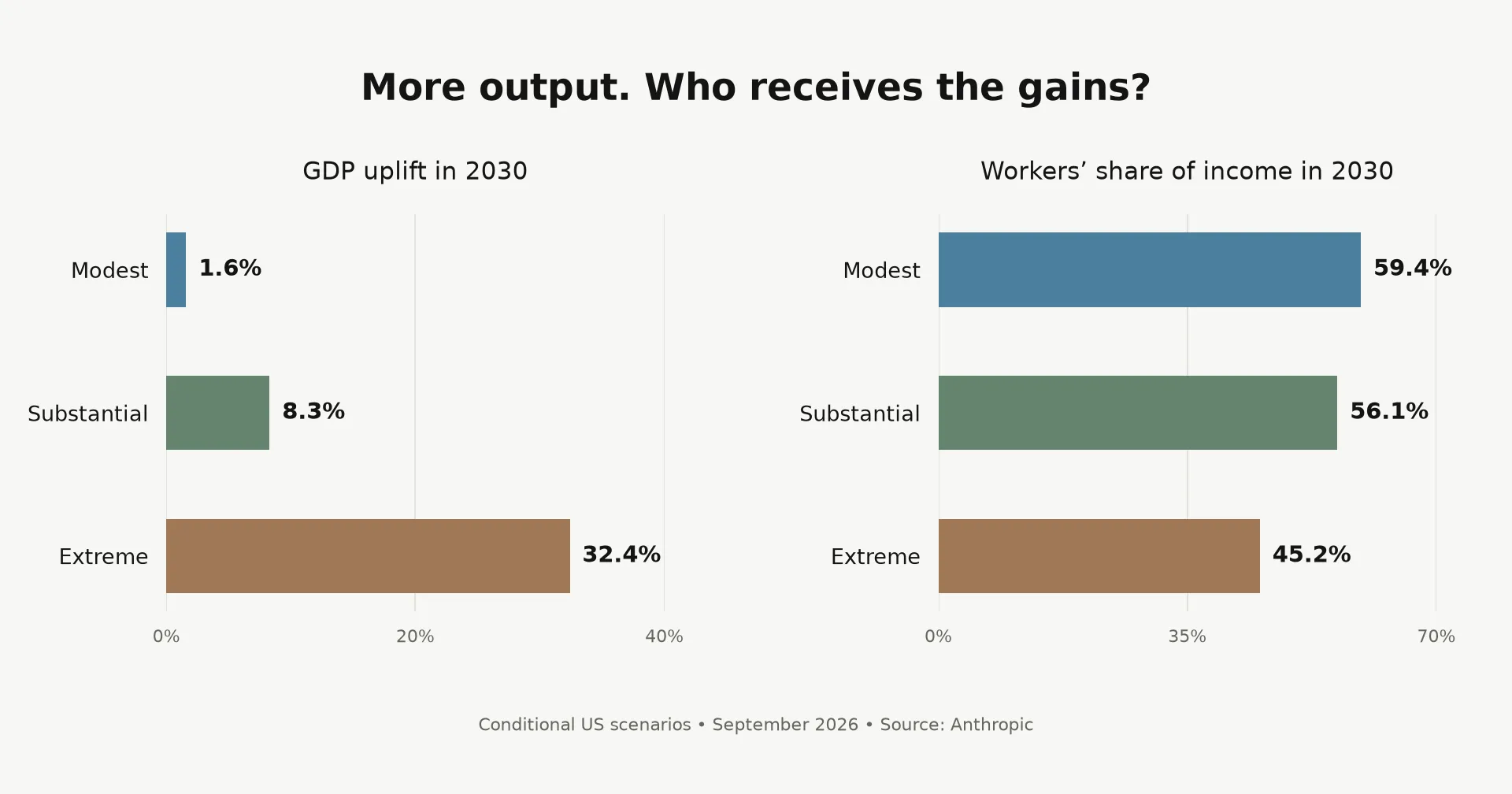
Imagine your company produces more, your team works faster, and your salary barely moves. That is the tension I find most interesting in Anthropic’s new economic scenarios: an AI success story can still feel like a personal setback.
The scenario explorer looks at possible US outcomes through 2030. These are conditional scenarios, without assigned probabilities. Technical report
The picture that stayed with me
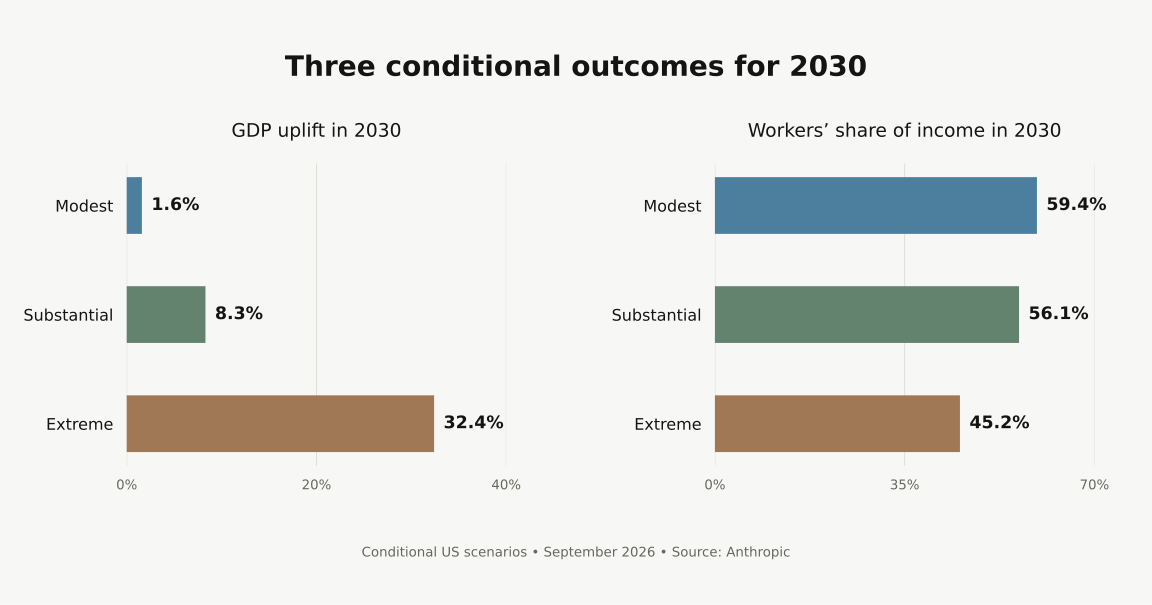
In the strongest scenario, more output comes with a smaller worker share. A falling share does not itself mean everyone’s paycheck falls. But the report also models weaker knowledge-worker wages and difficult occupational transitions. Anthropic report
My reading is simple: we should ask who receives the value created by AI whenever someone celebrates a productivity gain. A bigger economy is welcome. It is an incomplete answer to someone worried about next month’s rent.
Your job title tells only part of the story
Think about your own week. Writing a first draft, checking a result, understanding a customer and accepting responsibility for a decision are different kinds of work, even when they sit inside one job.
I would start there rather than with a list of supposedly safe professions. Which parts can you delegate confidently? Which still need your judgment? Where would an unnoticed mistake hurt someone?
For a developer, producing code faster is useful. Deciding what should be built, checking whether it works and owning the consequences remain questions worth asking. I would not assume those responsibilities will always protect a job. I would use them to decide where to deepen my skills now.
Faster work deserves a better conversation
Consider a hypothetical team that finishes a weekly report in two hours instead of eight. The six hours saved could fund better analysis, a shorter working week, more assignments or fewer positions. The software does not choose between those outcomes. Management, contracts and bargaining do.
That is where I think the AI conversation needs to become more concrete. “We are becoming more productive” should lead to a second sentence: what changes for the people doing the work?
If you are an employee, keep examples of improvements you have delivered: time saved, errors caught, customers helped. They give you something specific to discuss. If you run a small business, decide how you will use the saved time before it quietly becomes another round of pressure on your team.
Useful, with limits
The model leaves out policy responses, business cycles and advanced robotics. Its US results are not a forecast for Spain or Catalonia. Model limitations
I also read it knowing that Anthropic sells AI. That does not invalidate the work; it makes independent scrutiny valuable. I find the explorer useful for testing assumptions, but I would not use its most dramatic scenario as a personal career prediction.
My view: learn to use AI, keep your professional judgment sharp, and ask how the gains will be shared. The question I would take into the next workplace conversation is this: if we can do more with less effort, what will actually get better for us?